Albert Emil Kirchner’s Blick auf Florenz (View of Florence), painted in 1865, captures the romantic allure of Tuscany from an elevated vantage point on a splendid sunny day. This oil on wood (or canvas in some references) panel, measuring about 39 x 33 cm, showcases Kirchner’s skill as a 19th-century German landscape painter (1813–1885), who trained in Munich and traveled extensively across Europe. The work bathes Florence’s iconic skyline, likely featuring the Duomo, Giotto’s Campanile, and Palazzo Vecchio, in warm golden light, evoking the city’s enduring Renaissance splendor amid Hegau region’s artistic gaze.
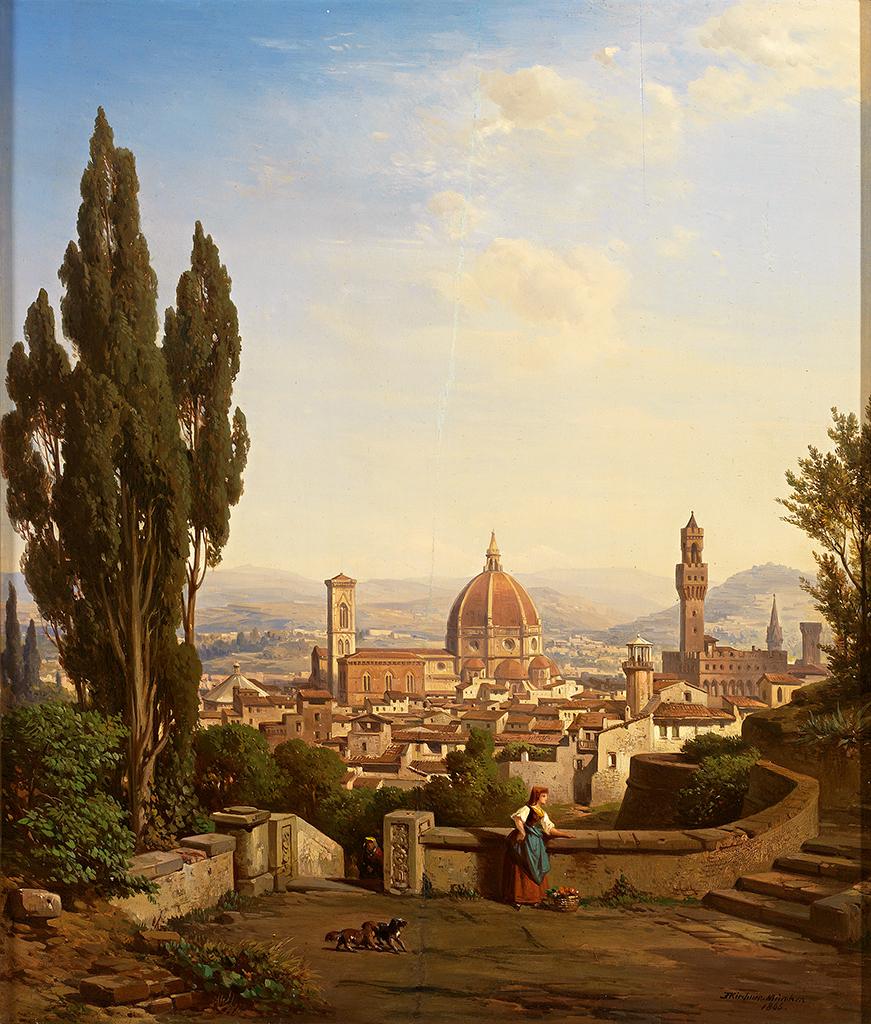
Albert Emil Kirchner (1813–1885) was a German painter rooted in 19th-century Realism and Biedermeier traditions, specializing in meticulously detailed landscapes and architectural views. His style emphasized precise observation, luminous atmospheric effects, and a balanced composition that captured the grandeur of European cities like Florence and Italian vistas. Works such as Blick auf Florenz (1865) showcase his ability to blend topographic accuracy with subtle Romantic sentiment. golden sunlight bathing terracotta roofs and domes, foreground foliage adding intimacy to panoramic scenes.
Kirchner renders the Arno River winding through terracotta rooftops and distant hills with meticulous detail, blending Biedermeier precision and early Romantic atmospheric effects. Sunlight dances across domes and towers, casting soft shadows that add depth and luminosity, while foreground foliage frames the panorama intimately. This elevates a topographic view into a poetic tribute, reflecting 1860s wanderlust among German artists post-unification.
Trained at the Munich Academy under Julius Schnorr von Carolsfeld, Kirchner absorbed the Nazarene movement’s ideals of clarity, idealism, and classical harmony, favoring clean lines over dramatic expressionism. His technique involved fine brushwork for textures (stone, water, foliage) and a restrained palette of earth tones warmed by sunlight, evoking nostalgia for pre-industrial harmony. This positioned him between Biedermeier’s domestic precision and early Romanticism’s awe of nature and antiquity.
Influences included travel across Italy, Switzerland, and Germany, where he sketched en plein air, drawing from 17th-century Dutch masters like Jan van der Heyden for urban detail and Caspar David Friedrich for emotive light. Munich school contemporaries shaped his polished finish, while Baroque elements appear in dramatic skies. Overall, Kirchner bridged academic rigor and wanderlust, creating enduring topographic poetry
The painting’s provenance includes Berlin collections and Nazi-era looting records, now traceable via databases like Lost Art. Auctioned in 2012 for modest sums (similar Kirchner views fetch €2,000–12,000), it exemplifies overlooked 19th-century gems blending realism and sentiment.