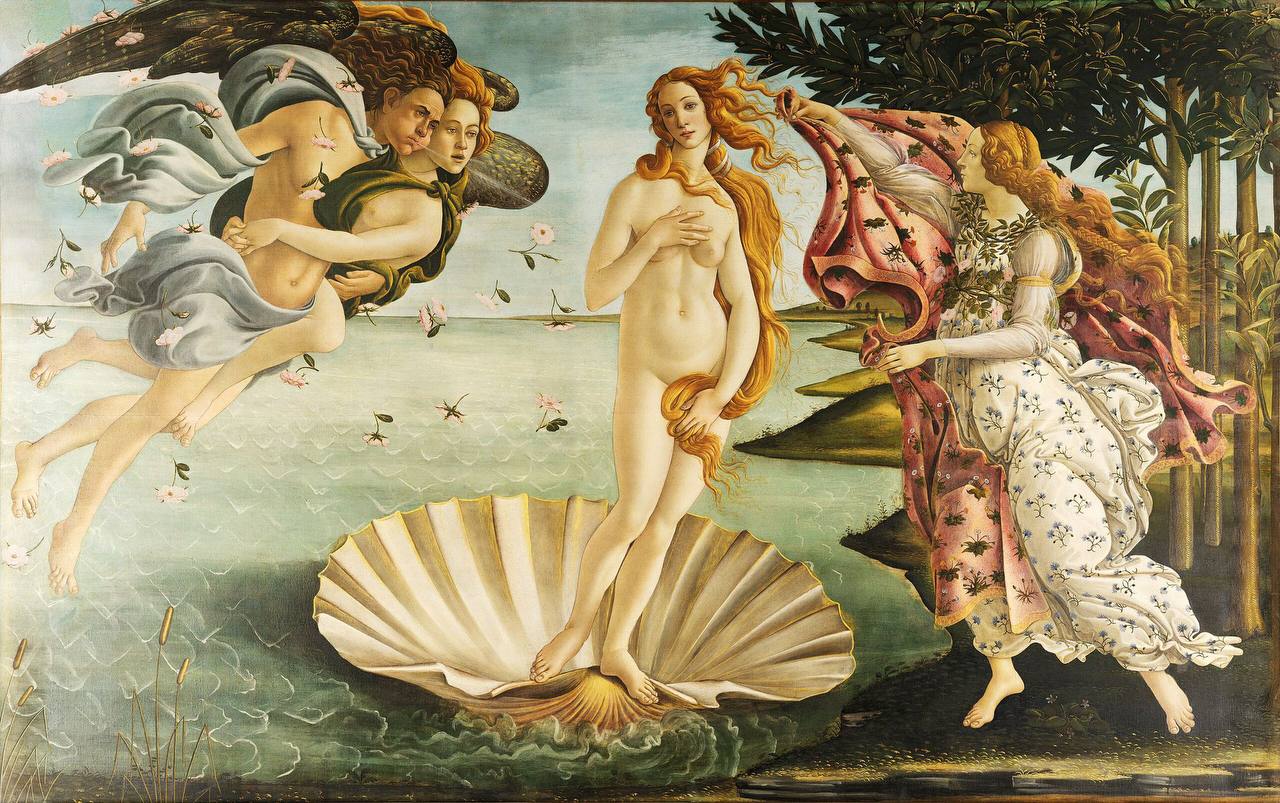
Sandro Botticelli’s The Birth of Venus, painted around the mid-1480s, is one of the most celebrated masterpieces of the Italian Renaissance. Created for the Medici circle in Florence, it marks a decisive moment when mythological subject matter, drawn from classical antiquity, was elevated to the same prestige as religious painting. The work depicts the goddess Venus emerging from the sea upon a shell, symbolizing her birth, and it translates a poetic and philosophical vision rather than a literal narrative. At over five feet tall, the canvas has a monumental presence that underlines the importance of its theme: the arrival of ideal beauty into the world.
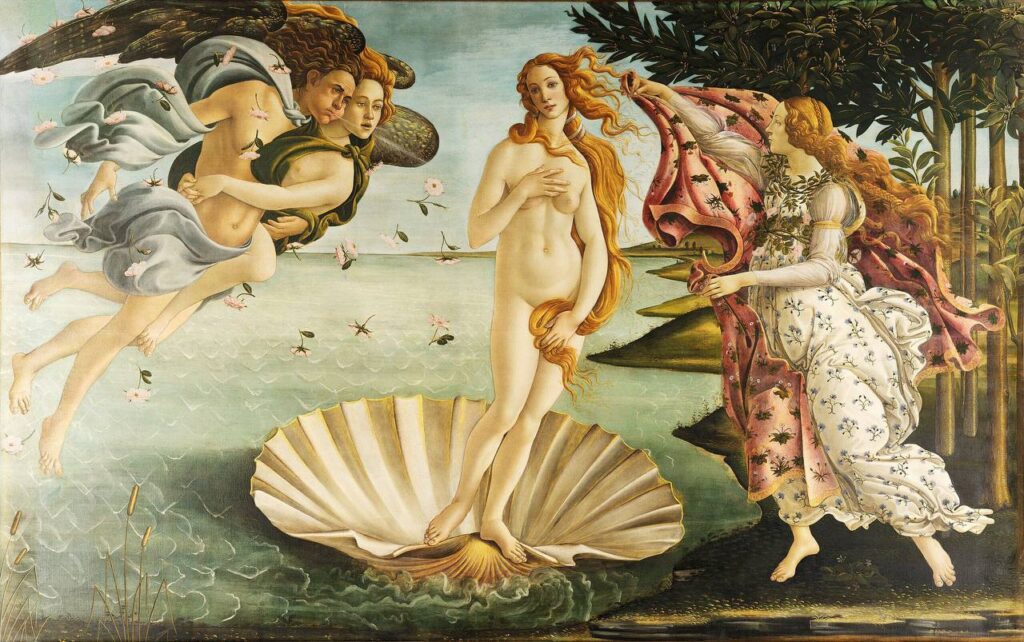
At the center stands Venus, nude yet modestly covering herself in the so-called “Venus pudica” pose derived from ancient Greek sculpture. Her elongated body, impossibly graceful stance, and flowing hair do not reflect naturalistic anatomy so much as an idealized, spiritualized beauty. Botticelli softens her outline with delicate contours and uses subtle shading to give her a porcelain-like luminosity, emphasizing purity and otherworldliness over physical realism. Her calm, almost introspective expression suggests an inner life, aligning her with Renaissance humanist ideas about the nobility of the soul.
To the left, the wind gods Zephyrus and Aura (or Chloris, depending on interpretation) blow Venus toward the shore, their intertwined bodies wrapped in a flurry of drapery and blossoms. Their winds scatter roses—flowers associated with both love and the pain that can accompany it, hinting that Venus’s beauty will bring both delight and suffering into the human realm. The movement of their bodies and garments contrasts with Venus’s vertical stillness, creating a dynamic interplay between chaos and order, nature and ideal form. The billowing lines of the cloth and hair are quintessential Botticelli, whose linear style privileges rhythm and pattern over depth.
On the right, a Hora of spring, one of the goddesses of the seasons, waits to clothe Venus in a richly patterned floral mantle. This gesture symbolizes civilization’s embrace of divine beauty and the transformation of raw, elemental birth into cultured, social presence. Her embroidered dress and the orange grove in the background allude to the Medici family, whose emblematic oranges and patronage linked them with the flourishing of art and philosophy in Florence. The decorative elegance of the garments and foliage shows Botticelli’s roots in Florentine workshop traditions, where textile design and painting were closely connected.
Beyond its narrative, The Birth of Venus is often read as a visual manifesto of Renaissance Neoplatonism, a philosophy that reconciled pagan myth with Christian thought by treating Venus as a symbol of spiritual love and divine beauty. In this view, the viewer’s contemplation of her ideal form becomes a path from physical attraction to higher, intellectual and moral insight. The painting thus operates on multiple levels: as a revival of antiquity, a celebration of Medici culture, and a poetic image of beauty’s power to elevate the human mind. Its continued fame lies in this delicate fusion of sensuality and spirituality, where a mythological scene becomes a timeless meditation on what beauty means.